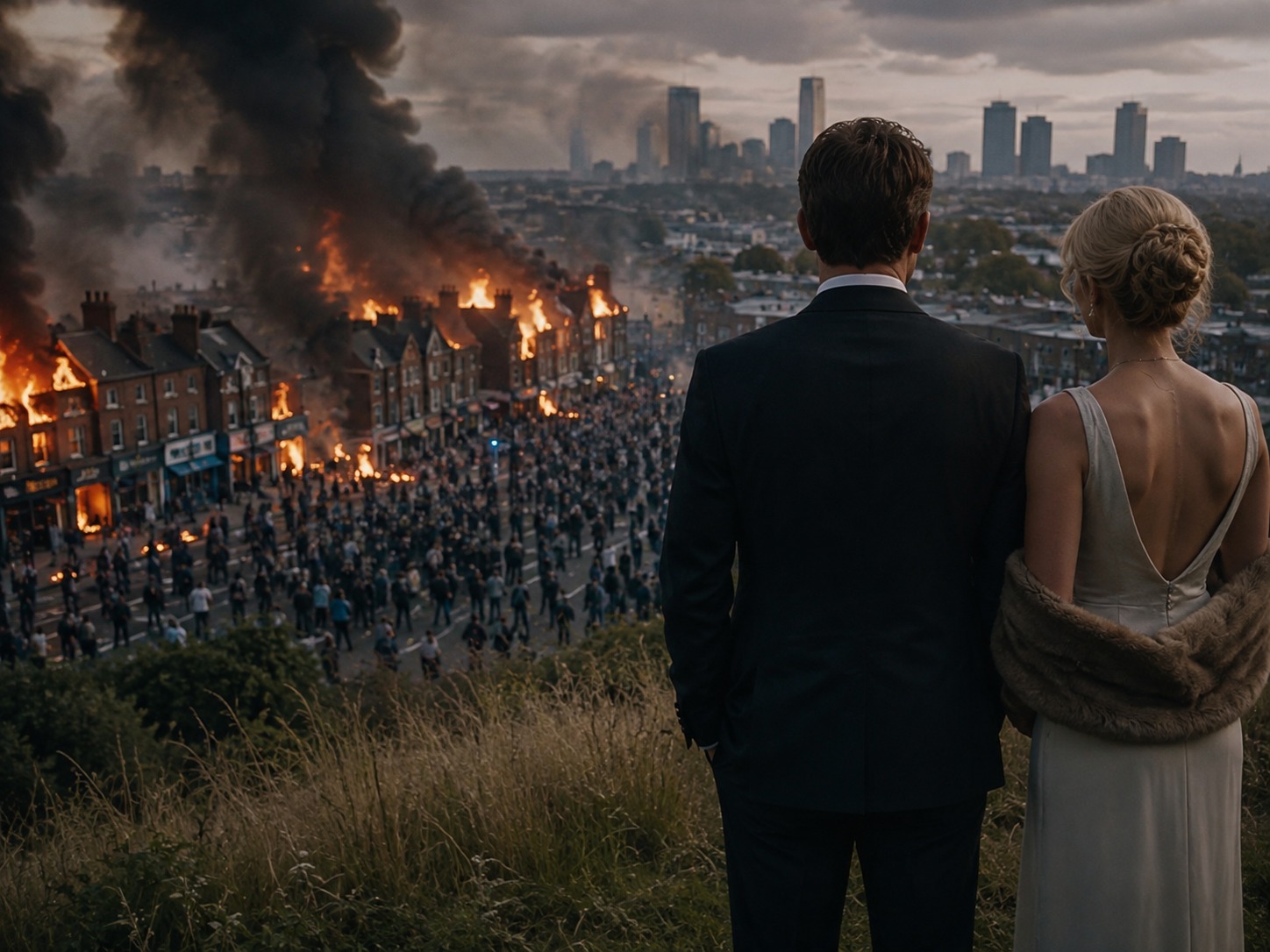
Daniel Johnson: George, explain to us how in your view the riots in England in August illuminate the problem of our anti-elitist elite.
George Walden: The riots took place within a culture. Now people are asking themselves quite rightly: how on earth did that come to arrive? David Cameron himself has spoken about a destructive culture and others have said actually the culture of cupidity applies in the City as well as in the scenes on the street. What interests me as the author of The New Elites [Gibson Square, 2006] is the role of what I call the anti-elite elites in producing a culture of anarchism and nihilism. I don’t think it’s too much to say we have the worst underclass in Europe and we’ve seen their powers of destruction. But before we can get on to this we need to ask ourselves who are the elites.
When you ask that, no one puts their hand up. What they are not are some sort of aristocratic rump in the House of Lords or people who chunter Latin tags. That is not the modern elite. By elite I mean people with power and influence, not just status or money. The people with the real power and the real influence are in my view the egalitarian elites in politics, the media, business, the arts. De Tocqueville has to come into this — he warned about some of the penalties of democracy: that it could give rise to “an anonymous despotism for which no one would stand responsible”. I think by that he meant populism — a sort of despotism of the masses. People with power and authority, and with money and education do have a responsibility for the culture which we have, and their overriding culture of condescending to the masses, using masses in the old sense, is uniquely damaging.
And so it’s important to reject the idea of the old elite. The new elite is by no means a stratum of society which even affects to stand for higher values any more in the way it once did.
The whole thing is summed up by Cameron and Tracey Emin, which is a tedious but revealing metaphor. Cameron, who is who he is — not his fault but he’s a well-educated guy with money. Tracey Emin is a talentless woman from a poor background. Cameron’s gesture of hanging a worthless object made by this woman in No 10 Downing Street is a supreme act of condescension and, in a way, goes to the core of what I’m saying because this type of act is taken much further every day in the media, and television in particular, and in the arts and in politics, i.e. playing down to the lowest cultural levels in Britain. Mostly for money, it has to be said. And this has done huge damage to the culture in general.
DJ: Nick, in your book Waiting for the Etonians [Fourth Estate, 2009] you delivered a devastating critique of what you call liberal England — how it had betrayed its own values and rather, as George has suggested, went after the money, went a bit crazy and then we had the crash. To crudely summarise your thesis, the British people turned back to the old elite as you saw it — the Etonians, the Bullingdon Club — the people who we never thought since the Sixties we would see back. A year or two on, how does it look to you and what do you say to George’s thesis?
Nick Cohen: He talks about money and it’s quite important to follow the money on these things. I agree with a lot of what George says. George’s argument is against egalitarianism. I agree that we are burdened with a condescending elite in culture, in the arts, in the press-very much in the press-and to some extent the BBC that panders to mass taste. But I am a little wary of saying that the trouble with Britain is that it suffers from too much egalitarianism when we have divisions in society which are wider now than at any time since the 1920s. I’ve been shocked by the behaviour of the Conservatives since the crash. Until 2008 you could say reasonably that the free market delivers the goods, you may not like bankers in Kensington but that’s the way it works. But now it doesn’t work. The public, George’s masses, have had to reach into their pockets to bail out the richest and most privileged people in the country. And that seems to me to have changed everything. Stagnation seems to go on for ever, but we are struggling to face it and move from the world which was essentially Tony Blair’s world that George described and analysed well.
It is unfair to blame Blair for all of it. If Blair were here he’d be able to throw all sorts of things at you. But it was that world of the Millennium Dome and Greg Dyke and Tony Blair, which flourished during the longest boom in the history of capitalism. That boom has gone. Remnants of its thinking are left behind like fossils after a mass exinction but it doesn’t seem to me that George’s description is a true description of how Britain is any more.
GW: I accept your point on egalitarianism. We agree because I’m talking about false egalitarianism. Egalitarian elites wear the masses’ clothes. They affect to like, or even worse actually do like, the masses’ musical tastes. But of course they live in a completely different world financially and in different parts of town. On Blair, I agree with what you say. Financially there has been a huge rupture between the two eras of Blair and Cameron. Yet these are the same people. Before Blair and Cameron you had Callaghan, you had Thatcher, you had John Major. None of them ingratiated themselves with mass culture in the way that Blair and Cameron have done. That seems to me rather important.
NC: I’m not disagreeing with you that Cameron models himself on Blair to some extent. But in important respects he doesn’t, actually. For instance, he’s not tough on crime, whereas Blair would always automatically have a tough criminal justice policy. If I’m allowed to quote Italian Marxists in Standpoint, Antonio Gramsci said: “The old is dead and the new cannot be born.” You still have politicians, people in the media going on in the same old way, a way of thinking which good times have embedded. Starting with the Thatcherite revival in the Eighties and building during the long boom of 1992 to 2008, we have had a continuous period of success and enrichment for people at the top. Those underneath have not been so lucky. An interesting thing about Britain is that we’re starting to get like America. Average wages in Britain started stagnating in 2003 just as average wages in America haven’t risen at all perhaps for a generation. We have an elite brought up in a boom culture finding itself in a new world where there’s a recession, and none of the old levers work and they don’t know what to do. And the danger of George’s argument is that it misses how lost the elite are. I was struck by the confidence of people around Blair. They would say, “Oh Nick, shut up, blabbering on about this, blabbering on about that. We understand this country, we know how to run it.” Their successors don’t.
GW: Meanwhile, what is a culture? Clearly it is linked to education, a subject of which I try not to talk too much now because it’s very easy to bore oneself. In parallel to what you are talking about you have had a huge decline in meritocracy in Britain. Since I wrote my book on the new elites several things have come to pass. One is that the gap in Britain between private schools and state schools is now the biggest in the Western world. One reason for that is because the average private school is very good compared with its equivalents in the rest of the world.
I should stress that I don’t believe in meritocracy any more than I believe in democracy. I just think that they are the least worst systems. Given that his father, Lord Young, was the author of The Rise of the Meritocracy, it is incidentally quite ironic that Toby Young is setting up a free school that if it had a meritocratic, selective system, could probably get him arrested for misuse of public funds. I think that Michael Gove is pointing in the right direction, but there is one essential point which he shuns and that is the selection issue. Cameron, like the Left, is viscerally against it. Do you remember the row that came up about new grammar schools? The whole idea of these ghastly aspiring lower-middle classes doesn’t please him. But in the private sector, one of the reasons for its success is that it’s rigorously selective academically, generally speaking, it’s rigorously selective financially and it’s selective socially. And so you have a situation which is paralleled in no other country where selection and to a great degree aspiration is for the seven per cent at the top of society. It’s not only discouraged but also banned in the rest of society, except of course in existing grammar schools.
NC: Let’s agree on something. Obviously if you abolish selection in the state system you are going to give the wealthy the greatest advantage. Abolishing grammar schools was the biggest favour the Labour movement did for the British rich, without doubt. If you have a private selective system and a state comprehensive system you end up with David Cameron or Nick Clegg. And in some ways it’s not wrong to have Cameron and Clegg in power. At least they’ve had a decent education. People at the top of British politics have either come come from the Scottish education system, which isn’t that bad, or the English private system. Hardly anyone has come from the English comprehensive system. And let’s also agree that what makes privilege very hard to fight in Britain is that it is privilege protected by a bodyguard of egalitarians.
If you were to say we need selection in state schools to help working- and middle-class children, the presenters on the Today programme would — well, I actually once heard Sarah Montague virtually squeak when someone mentioned selection in the state system. And of course, she went to a private school, which is a highly selective, highly privileged system. And if you were to say to her, “Well, look Sarah, you’re just following the interests of your class,” she probably wouldn’t understand you. And in her mind she thinks she’s being liberal and radical and fair-minded.
GW: The other thing she would say would be, oh you want to go back to the 11-plus, just as if you criticise the gap between state and private schools you are told you want to abolish private schools. These are all reasons why I abstract myself from this debate. It is demeaning to be involved in the subject on that level. There isn’t in my view a serious debate on education because no one is willing to tackle this selection issue.
DJ: Can I just bring us back to the riots and their connection with this condescending anti-elitist elite, whatever causes we may attribute to the riots, whether it’s the financial situation or whatever. How do we get from this dumbing-down and mass condescension to mass violence on the streets of London? This is something we haven’t seen before, at least not for a long time.
NC: A lot of it is just herd mentality. The police are screaming at David Cameron for saying so but the police appeared to back off. If the police give the impression that you can go out on to the streets and loot, then people will do it, I’m afraid.
DJ: So it’s a simple law-and-order point, then?
NC: To an extent I think it is. I’m a bit wary of the “O tempora, O mores” stuff.
DJ: So none of this broken society stuff?
NC: Let’s go through a few things that are being said. If you read Conservative newspapers you hear that we have a weak criminal justice system. In the 1980s, when George was in parliament, about 50,000 people were in prison. Now it’s well over 80,000. Crime has been falling in Britain since Blair in the mid-Nineties. We are actually quite tough on crime in Britain. So there’s that. Then people say, well it’s the blacks, its black culture. I went to a magistrates’ court and none of the defendants were black. What really gets me about it is that no one is ever shocked any more. No one ever says, “I used to think this but…” To go back to my example of the banks, I used to think free markets worked, but look what’s happened to the banking system. They’re like British Leyland or the miners in the Seventies. “I’m a Conservative so I’m against that”-no one ever says that. People just keep going down the same tracklines. Whatever happens, they just fit it in.
DJ: Is that a kind of moral relativism, do you think?
NC: No, it’s dogmatism, for instance on the riots. Certainly the riot in Tottenham was started by black gangsters but then you look across London. Who are the people being arrested? Are they from broken families? Were they unemployed or were they not? These are empirical questions, yet people don’t wait, don’t go and sit in the back of a magistrates’ court, they just say whatever they would have said anyway. It’s like pressing a button on a machine and generating the same answer whatever the conditions you apply to it.
GW: Obviously I wouldn’t suggest that the culture of condescension can explain the riots. I’m claiming they are an aspect of it.
NC: How?
GW: It’s partly education but mostly the media, and above all television. It’s tiresome to have to remind people but what had David Cameron done before becoming prime minister? The only job he had was with the trashiest TV company around, Carlton, in which he was the PR man and I remember one of the shows he was promoting was called A Woman’s Guide to Adultery.
Now I’m not condemning that programme. Someone is going to do that-Richard Desmond, he does it. Unlike David Cameron, Richard Desmond does not get up and make high-sounding speeches a few years later, quite oblivious, it seems, to the fact that there may be some contradiction with his previous behaviour. That has a certain symbolic value because it’s not just him, it’s his friends. Let’s not get too deeply into the News of the World, but look at that circle. What were those people doing? And the very presence of someone like Andy Coulson in No 10 is sociologically fascinating because here is a man from a very different background who is appropriated, let us say, by Cameron basically as part of his cultural condescension, i.e. to get through and ingratiate himself with the masses.
As it happens, I fought a battle over quality television and had huge arguments with Mrs Thatcher on precisely this theme. What I said to her and my fellow ministers at a lunch at No 10 was: “You cannot go around preaching about the importance of education and sell off television franchises to the highest bidder,” which is what she proposed to do. The other ministers were appalled that I’d contradicted her so bluntly, but later she invited me for a private drink. We argued again, she got the point, and introduced a quality threshold. Now, can you imagine doing that with Cameron? I think he’d say, “Oh George, you’re being frightfully elitist.”
NC: Aren’t you and Daniel arguing against the market? I used to mock businessmen who accused critics of anything from Big Macs to pornography of being elitist. Look at these guys in their suits and their cars. How dare they use the language of radicalism and revolution? But in their own terms, what they were saying was, we are the market. We give consumers what they want, if they don’t like it they don’t have to buy it, no one forces them. So aren’t traditional Conservatives in a bind that they don’t quite recognise?
When your Conservative colleagues argued against you and said: “Come on George, why shouldn’t we sell off television? If a station doesn’t produce programmes that people like it will go bust,” they were arguing for the market. I suspect you don’t like it and I suspect Daniel doesn’t like it but you can’t bring yourselves to say that actually we need to be a bit more statist, we need more controls on the market, because your ideology prevents you from saying that.
GW: Everyone accepts that in cultural matters there has to be some control of the market. Over obscenity clearly. But that’s not my point.
Let me give you three names: Peter Bazalgette, David Elstein, Dawn Airey — all of them privately educated and Oxbridge people. Bully for them. All of them too are now big speechifiers about the values of the media and so on. All of them made millions out of the lowest form of trash. I’m not condemning these people. I’m just observing that this doesn’t seem to be a particularly healthy society when you have an elite who, far from standing up for what you might portentously call higher values, actually have their noses in the smelliest trough.
NC: I agree with Stephen Fry on Peter Bazalgette. His great-grandfather was a great engineer and devised London’s sewer system to pump the shit out of people’s houses and his great-grandson is now pumping it back in. Is your objection to Peter Bazalgette that he’s had this great education and privilege but produced nothing worthwhile? An objection which I would entirely agree with. Or is your objection that he’s had this great education, had all these advantages and done nothing with his life but is still honoured? What seems odd (and you notice it at the BBC a bit — though there are more good people at the BBC than Conservatives sometimes realise) is that on the one hand they want to say, we’ve got to abandon any sense of higher culture, morality and difficulty and just churn out any old stuff to keep the ratings, while on the other hand they want to be respected and treated as moral, serious people. You see that quite a bit in Britain. But I come back: if you are not prepared — I will be elitist about this — to direct BBC arts funding and say you’ve got to go upmarket, I don’t quite understand. If you’re not criticising the market, what are you doing?
GW: You asked whether I was condemning these people because they are well-educated and haven’t done anything. No, I am not. These people are totally free to use their education to become Marxists or go and run a brothel. What I do object to is people who camouflage their not very salubrious cultural activity under a veil of anti-elitism. That seems to me to be positively obnoxious. They are helping to condition adversely the culture of people on the lowest levels of society by feeding them crap. I think there’s a very strong streak of phoniness running through our society.
NC: I agree with that.
GW: Let me give you two examples just from the last few days. Stella Rimington, the former MI5 chief and this year’s chairman of the Booker Prize jury, said that novels ought to be enjoyable and we know what she means. She means they should be jolly. That rules out people like Dostoevsky. Not very jolly but rather a good novelist. This is condescension. Radio 3 is another example, because it too is quite clearly aiming downwards. It’s not just on the bottom levels where the main damage is done. The same disease is present at higher levels.
DJ: Can I just broaden it out a bit? Some might say, what if Britain does dumb down in this way? Who cares? But some would say, for example the Chief Rabbi Jonathan Sacks in Standpoint and elsewhere, that actually this is very important, that it’s an example of the West abandoning its core values and that when that happens for any length of time, an entire civilisation collapses and is replaced by something more dynamic. We don’t have to look very far to see India and China forging ahead. There’s the Islamic world, and so on. How do we compare with other countries in this respect? Are we uniquely decadent or not?
GW: Having lived much of my life abroad, one thing that increasingly strikes me about Britain is that there is less and less moral restraint. We talk about the Church of England as if it is a serious church. But there aren’t any churchgoers. I think it’s down to about seven per cent now. The only time the Archbishop is mentioned is when he talks about homosexuality or women priests or makes yet another galumphing and in my view immoral attack on the government — immoral because he can’t even get his own organisation in order so who is he to preach to other people?
So I don’t think there’s any religious authority in this country. France is educationally secular but socially more Catholic. Then of course there’s religion in Germany, not to mention America. In China there is clearly not only the weight of tradition, which should not be forgotten, but also the weight of the government to keep things in order. Here you have a working-class culture which has largely gone for numerous reasons, along with its industries, which was conservative in many ways. You only have to go to the north-east of England to see this. The Church has gone, the Labour Party doesn’t stand for anything in cultural and educational terms, and there are few constraints at school or in the family.
I remember Chris Smith saying culture is not just for the cognoscenti. Well, cognoscenti as I understand it means people who know what they’re talking about and I wouldn’t mock them. So if the culture is dominated by people who don’t know what they’re talking about, you have the trahison des clercs, except in this case the clercs probably haven’t read the Bible. And so I don’t see where any restraining force comes from any longer in Britain, particularly at a time, dare one mention it, when not only are we trying to cope with our own cultural malaise but we are importing large numbers of people who are not necessarily from saintly backgrounds or with functioning cultures of their own.
DJ: What do you think about this, Nick? Do you think the elite have let the country down? Both the liberal elite and the new Tory elite.
NC: Let’s take that from the top. From a left-wing point of view, however much you and George might have objected to a Labour government, however much you thought what these guys were going to do was to put up your taxes, get a lot of money, and waste a lot of it, be bossy, be Fabian, and think the man from Whitehall knows best, the one thing you’d have thought they’d be able to do was regulate the banks. Even if you had spent your whole life campaigning against the Labour Party, you’d think at least we won’t have a banking crash. I’ve checked the history books and never before had a centre-Left government presided over a banking crash. Admittedly Ramsay MacDonald’s 1929 government was in power when the Wall Street crash happened but it only came to power in May and the crash happened in the autumn and in America. Throughout the 1920s and ’30s not a single bank in Britain or the British Empire went bankrupt — not one. You have to go back to 1866 to find something like that happen.
So yes, the Labour Party let the country down hugely. Gordon Brown let the country down hugely. The idea that you could have a manic bull market under a Labour government and then for it to say, we’ll give public money away to bail these people out, is an extraordinary thing. It’s a sign of how weak social democratic culture has become in Britain that people are not amazed by what has happened. It’s not talked about that Gordon Brown and Ed Balls can appear in the street without people throwing horse manure at them. I don’t agree with Jonathan Sacks at all. If British culture, Western culture, depends on religion then we’re in a huge mess. It is impossible for serious people to believe in God any more, or at least the God of the Bible, the God of the Koran, the God of the Torah. You just can’t do it. So if you’re going to pin Western culture to decaying ideological systems then you’ve lost already.
Aside from that, this is where I agree a lot with George: there is a problem that people in universities, in schools, in the media, who believe in high standards have to defend themselves against vulgar, money-grubbing people who attack them. But they don’t have the language to defend themselves. They can’t just mock the people from television whom George was describing. Or say, “Why can’t you just be an honest scam artist? Why can’t you just say, ‘Hey, I’ve made a lot of money, I’ve got a nice house, I’ve got a nice car’, and leave us alone.” If they speak plainly this elite accuses them of being “elitist”. But then again, I’m not so pessimistic about British culture or indeed European culture.
DJ: Can you give us a reason for optimism?
NC: We have democracy. We have freedom of speech and freedom of thought and to some extent I’m arguing it should be extended. However poor a lot of universities are, about a third of young people are attending them. Incidentally, because of the crash, because of unemployment, students are going to be a lot more tough-minded and a lot more determined to learn than perhaps the preceding generation were because I noticed their shock. I am talking about those who were born in 1989, 1990, after the fall of the Berlin Wall, and all they had seen around them was a continuously growing economy. Their parents were able to say to them you can take a gap year, you can do this, you can do that, but as long as you work hard and go to university it will be fine, and now it’s not. And so they are toughening up.
DJ: I hope they are toughening up. The first thing they did was riot last Christmas and it was the riots of the elite that preceded the riots of the underclass.
NC: That’s an interesting point. But it’s easy to be despairing about free societies at the moment because it is a corrupted Communist dictatorship that is the world’s booming economy. It is Putin’s Russia which is doing quite nicely, thank you. India and Brazil are democracies but remarkably corrupt democracies. It’s quite hard to resist the temptation to say, “Oh well, we’re all in terminal decline. I don’t know what we’re expected to do about this.” George seems to want the right to be very, very rude about people at the top of society, which is absolutely fine by me. I wish more people were. I wish people like Greg Dyke or Peter Bazalgette were stock figures of fun.
GW: Very powerful people.
NC: But beyond that, what do you want to do?
DJ: Yes, George, is there anything practical we can do?
GW: Well obviously there are things in education. I’m not as pessimistic as you suggest. A lot of people of my generation have no reason to complain about anything. Why? Partly because we had far more opportunities to advance financially, culturally, career-wise, than are going to be open today. I am not very optimistic for the next generation, which is why I wrote a book entitled Time to Emigrate? a few years ago, predicting — dare I say it — everything that has happened since. I am a bit pessimistic, to put it mildly, about a 25-year-old couple living in London on average wages, whether it’s trying to find somewhere for their children to go to school, or for that matter finding somewhere to live. For them, I am pessimistic. But again, the people closer to the top of society with a certain amount of money will find a way through for their children.
For the rest I don’t see the future. Obviously I agree there are good people in universities and so on. I was higher education minister, I’ve met them. But they’re not the problem so I’m not talking about them. Some optimism might come from immigration, which I think brings huge problems lower down in society, but higher up there are various opportunities.
One of the things that may happen is that just as in the Thirties, when we got refugees from Hitler, we may acquire similar people. In all aspects of English life, it’s fascinating to look back at immigrants who made a significant contribution. I don’t think a book has been written on it, perhaps it has. There were Gombrich and Pevsner, on whom a wonderful book has just come out, Arnold Weinstock in industry and in publishing George Weidenfeld. They and many others of course provided a much-needed revitalising kick up the backside. Now, it seems to me self-evident that Asians, predominantly Indians because of their numbers, but also other groups, such as Iraqi Jews who seem to be curiously prominent in Britain, as well as other innately aspiring people, will just get on with it. I think in ten or 20 years, half of Oxbridge will be full of them and they won’t have these ghastly demotivating complexes because we are very complexed as a nation in terms of class and society. And maybe the best and brightest of this huge influx (many more of course than the Hitler victims in the 1930s) will help us shake off our cultural miasma. Some of the free schools with a large immigrant input might produce good people. But for the locals now in their twenties or their early thirties it doesn’t look good.
NC: I’m being slightly reductionist but I do believe in the primacy of economics in the sense that in the boom years the Conservative governments to some extent and the Labour governments were saying they were going to let the City take the money from lightly regulated capitalism and use it to fund their social projects. Actually the City isn’t that important a part of the British economy — our computer and internet businesses, which are brilliant, are almost the same size. But no one talks about them because the City is big money and it’s right next to Westminister and Fleet Street.
That model has fallen apart. It’s a model that David Cameron signed up to when he went along with Gordon Brown’s spending plans and it’s been blown apart. Britain needs to find other ways of doing business, find ways that give working- and middle-class people a reasonably stable career to aspire to. It’s about time, I would say, to go back to a slightly more statist, controlled economy to do things like build houses and get things going. The irony of the times is that this is about one of the most left-wing moments in my lifetime by a mile. Whatever you say, you can’t blame what’s happened on trade unions or bureaucrats. You can’t blame George’s empty and shallow and vaguely leftist, vaguely liberal cultural elite. This is high finance running out of control and bringing the roof down on the rest of the country. But you’ve got a centre-Right movement that isn’t very well-equipped to do something different and you had a centre-Left government that let the financiers do it in the first place.
So, as I said at the beginning, things are going to have to change. It’s easy to say we need a different kind of Britain but it’s very hard to see how we get from where we are now to there and it’s even harder to see who will be a reliable guide.
GW: To sum up, I would say that I will accept that we probably need different financial arrangements, if you, Nick, will admit that we need a different kind of culture.
YARPP Thumbnails
YARPP Thumbnails